First Impressions: Shanghai vs New York
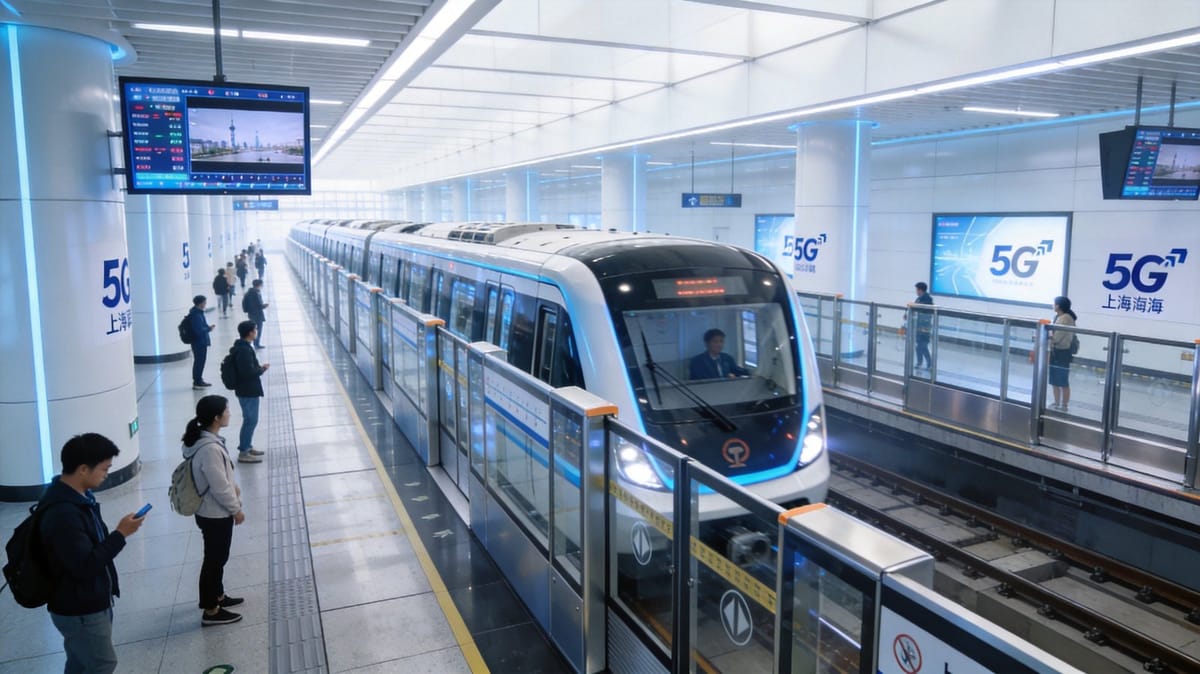
My first ride on the Shanghai Metro was in 2019. I came out of Pudong International Airport, hopped on Line 2, and was whisked across the Huangpu River into the heart of the city on a train so smooth and quiet I could barely tell I was moving. The station was spotless. The platform had glass screen doors. The train arrived in exactly two minutes, and a digital display told me when the next one was coming. I paid by scanning a QR code on my phone — no ticket, no card, just a quick wave of the screen.
Three weeks later, I was in New York. I descended into the 125th Street station on the 1 line and immediately understood why every New Yorker has a love-hate relationship with the subway. The station was dim. The tile walls were cracked and stained. A rat the size of a small dog surveyed the platform like he owned the place. The train was late, the car was hot, and the PA system crackled out an announcement I couldn't understand if I tried.
Two cities. Two subway systems. Two completely different centuries of experience.
Here's the number that puts it in perspective: Shanghai opened its first metro line in 1993. By 2025, it had 890 km of track and 415 stations, making it the longest metro system in the world by route length. New York opened its first line in 1904. After 121 years, it has 399 km of track across 424 stations. Shanghai built more than twice the track length in less than a third of the time.
And Shanghai is just the beginning of the story.
China's Metro Building Spree By the Numbers
As of December 2024, China has 54 cities operating urban rail transit systems — 325 lines totaling 10,945.6 km with 6,324 stations. In 2024 alone, China added 748 km of new track across 18 new lines and 27 extensions. The country carried 32.24 billion passenger trips on urban rail in 2024, up 9.5% from the previous year.
The scale is almost incomprehensible. Consider the top metro systems by track length in 2024:
Beijing Subway: 891 km, 404 stations, 3.62 billion annual riders
Shanghai Metro: 890 km, 415 stations, 3.77 billion annual riders
Guangzhou Metro: 780 km, 317 stations, 3.26 billion annual riders
Shenzhen Metro: 622 km, 332 stations, 3.10 billion annual riders
Chengdu Metro: 716 km, 363 stations, 2.21 billion annual riders
Five Chinese cities each have more track than the entire New York City Subway (399 km). Four of them carry more annual passengers. Eleven of the twelve longest metro networks in the world are in China. The one exception? London, which took 162 years to build its network.
In 1990, China had metro systems in exactly three cities: Beijing, Hong Kong, and Tianjin. By 2024, that number had grown to 54. In 30 years, China went from having barely any subway infrastructure to owning the global leaderboard. The International Association of Public Transport (UITP) noted that in recent years, China was building more new metro annually than the rest of the world combined.
New York: The Once-Great System That Time Forgot
Let me be fair to New York. The NYC Subway was an engineering marvel when it opened in 1904. It was the first city to build a truly large-scale underground rapid transit system, and for decades it set the global standard. Even now, it has one feature no Chinese metro can match: 24/7 operation. When Shanghai shuts down at midnight, New York keeps running. That's not nothing.
But the numbers paint a grim picture of decline. The NYC Subway carries about 2 billion riders annually — down from 2.8 billion before COVID and still recovering. Its on-time performance hovers around 65-70% on good days. Shanghai's on-time rate is 99.8%. I'll say that again: 99.8%. The difference is partly because Shanghai runs on modern signaling systems, while New York still uses signal equipment installed before World War II on many lines.
The rider experience tells the real story. In New York, you buy a MetroCard (or tap an OMNY reader if the station has one) and navigate a maze of corridors that often smell like they haven't been cleaned since the Giuliani administration. In Shanghai — and every other major Chinese city — you scan your phone at the gate and walk through a station that looks like it was built this year, because it probably was.
The NYC Subway's last significant expansion was the Second Avenue Subway's first phase in 2017, adding just three stations at a cost of $4.5 billion. That's roughly $2 billion per kilometer. China builds metro for approximately $250 million per kilometer in purchasing power parity terms — roughly eight times cheaper. Yes, labor costs are lower. Yes, land acquisition is easier when the government owns the land. But the gap isn't just about money. It's about whether a city can still build big things at all.
London: The Grand Old Lady of the Underground
At 162 years old, the London Underground is the world's oldest metro system. It's also one of the most expensive. A single Zone 1 fare costs £2.80 (about $3.50) during peak hours. A monthly travelcard for Zones 1-3 will set you back £176 ($220). Compare that to Shanghai, where a typical ride costs 3-5 yuan ($0.40-$0.70), and Beijing, where the flat fare is just 2 yuan ($0.28) for short trips.
London's system is vast — 11 lines covering 402 km — but aging. The Northern Line still uses sections of tunnel from the 1890s. Signal failures are routine. The deep-level tubes are cramped, hot, and claustrophobic. When temperatures hit 30°C (86°F) in a London summer, the Underground becomes a moving sauna. In a 2025 transit power ranking by Dodie's World, London scored just 60 out of 100 for comfort — the lowest among the six major systems ranked.
To be fair, London is investing heavily. The Elizabeth Line, which opened in 2022, added 100 km of modern, high-capacity rail through central London. It's sleek, fast, and air-conditioned — a taste of what the whole network could be with enough money and political will. But the Elizabeth Line took 13 years to build and cost £18.9 billion. China built the entire 622 km Shenzhen Metro — which opened its first line in 2004 — in roughly the same timeframe.
Tokyo: Efficient, Crowded, and Kind of Miserable
Tokyo's metro is, by most objective measures, the best-run transit system in the world. It scored 93.7 out of 100 in the 2025 Global Mass Transit Power Rankings — first place, ahead of Seoul (93.5) and Shanghai (90.8). The trains are punctual to the second. The network is dense. The coverage is extraordinary.
But "best" doesn't mean "pleasant."
Rush hour on the Tokyo Metro is the stuff of legend. White-gloved attendants literally push people into cars so the doors can close. Personal space is a distant memory. The trains are clean and quiet, but the experience of riding one during peak hours is more like being packed into a horizontal elevator than traveling through a city.
Tokyo Metro itself has only 195 km of track — less than a quarter of Shanghai's network. When you add the Toei Subway and other urban rail, the total reaches about 450 km, which is still half of Shanghai's. The difference is density: Tokyo crams incredible ridership (about 4 billion across all urban rail) into a much smaller footprint. It works, but it works by accepting a level of crowding that would be unacceptable almost anywhere else.
There's also the technology gap. Tokyo's system is well-maintained but not particularly modern. Many lines still use older rolling stock. Contactless payment (Suica/Pasmo IC cards) is universal, but mobile QR-code payment — the standard in China — is rare. You can use your phone as a Suica, but you're essentially digitizing an old card system, not building something new.
Paris: Beautiful, Small, and Stuck in the Past
The Paris Métro has charm. The Art Nouveau entrances, the tilework, the way stations like Arts et Métiers look like something out of a Jules Verne novel — it's a working museum. But charm doesn't get you to work on time.
Paris has 321 stations across 16 lines totaling just 246 km. That makes it one of the densest metro networks in the world — stations are never more than 500 meters apart — but also one of the smallest by modern standards. The trains are narrow. The cars are short. Most lines still use steel-wheeled rolling stock from the 1960s and 1970s (the MF 67 series, which is 43-53 years old on average). Air conditioning? Not on most lines. Paris summers are getting hotter, and the Métro is not keeping up.
Paris is trying to modernize. Line 1 was fully automated in 2012. Line 14, the newest, uses driverless trains. The new MF 19 rolling stock, ordered in 2019 for €2.9 billion, will replace aging trains on eight lines by the mid-2030s. But the pace is glacial. China builds entire new lines faster than Paris replaces its trains.
The Grand Paris Express — four new lines adding 200 km of track — is the biggest expansion since the Métro's original construction. It was supposed to open between 2024 and 2030. As of 2025, the first sections are delayed to 2026, and costs have ballooned. Meanwhile, Shenzhen added 67 km of new track in a single year (2024).
The Experience Gap: From Ticket Gate to Platform
Let me walk you through a typical journey on a Chinese metro, step by step, because the difference is in the details.
Entering the station: No ticket machines. No MetroCard kiosks. You walk to the gate, open Alipay or WeChat, tap the transport code, and the gate opens. In Shanghai, you can even use facial recognition at some stations — walk up, the camera scans your face, the gate opens. No phone, no card, no nothing.
On the platform: Glass screen doors separate you from the tracks. No one falls onto the tracks. No garbage on the tracks causing fires. Digital displays show the exact arrival time of the next three trains. The typical wait is 2-3 minutes during peak hours, 4-6 minutes off-peak.
On the train: Clean, well-lit, climate-controlled. Real-time station information on overhead displays. Announcements in Mandarin and English. Phone signal throughout — and in Shanghai, full 5G coverage across all 896 km of track, completed in April 2025. You can video-call, stream, or download files while underground. Try that on the London Tube, where you're grateful if you can send a text.
Exiting: Same QR code scan. Some cities are piloting "walk-through" gates that detect your payment method automatically — no need to even slow down.
Now walk through the same journey in New York. Swipe a MetroCard that may or may not work. Navigate unclear signage. Wait on a platform with no screen doors, no arrival display, and trash on the tracks. Board a car with broken AC in summer or broken heat in winter. Lose your phone signal the moment you go underground. Arrive at your destination and hope the exit isn't closed for construction.
Both get you from A to B. One makes you feel like you're living in 2025. The other makes you feel like you're living in 1975.
Driverless Trains and 5G: China's Tech Leap
Here's where China pulls ahead not just in quantity but in quality. As of 2024, China has 54 fully automated (GoA4-level) driverless metro lines in operation, with a combined length of 1,484 km — a 41% increase from the previous year. The first driverless line, Shanghai Metro Line 10, opened in 2014. A decade later, driverless operation has become the default for all new metro construction in China.
Driverless trains aren't just a gimmick. They run more frequently, more precisely, and more efficiently than human-driven ones. On Shanghai's automated lines, the five-minute-delay rate is three times better than the network average. Operating costs are lower because you don't need drivers. And passengers can sit at the front of the train and watch the tunnel rush toward them through a panoramic window — a small thrill that never gets old.
The 5G rollout is equally impressive. Shanghai completed full 5G coverage across its entire metro network in April 2025 — 21 lines, 517 stations, 896 km of track. Over 80% of the network uses 5G-Advanced (5G-A) technology, with download speeds averaging over 600 Mbps and peaks exceeding 1 Gbps. Guangzhou achieved full 5G coverage in October 2024. Beijing, Shenzhen, and Chengdu are close behind.
This isn't just about letting passengers watch Netflix underground. 5G enables real-time train monitoring, AI-powered maintenance, and smart station management. Shanghai's 5G-equipped lines use AI to detect equipment failures, with 98% accuracy, and have reduced manual inspection workloads by over 80%. It's infrastructure that maintains itself.
Why China Can Build Fast and the West Can't
Speed isn't just about money, though China spends less per kilometer. It's about the entire system of building.
Land: In China, the government owns all urban land. When a metro line needs to be built, the route is planned, the land is allocated, and construction begins. In the US or Europe, acquiring land for a metro project can take a decade of negotiations, eminent domain battles, and community lawsuits. The Second Avenue Subway in New York was first proposed in 1929. It took 88 years to open its first three stations.
Labor: China deploys armies of workers and tunnel-boring machines simultaneously. During the construction boom leading up to the 2010 Shanghai Expo, over 100 tunnel-boring machines were operating at the same time. New York's MTA uses six for the entire system. Shanghai's deputy chief engineer Zhou Xisheng put it plainly: "What takes us one or two years takes them five to ten."
Politics: China's five-year plans include specific metro construction targets. Local governments are judged on whether they meet those targets. There's no opposition party to vote against funding, no community board to veto a station location, no environmental review that takes five years. The political system is designed to execute big projects quickly.
The Rail + Property model: Hong Kong's MTR pioneered a model where the metro operator develops real estate around stations, using the profits to fund construction. Chinese cities have adopted this at scale. Metro lines increase land values; government-owned land is then leased to developers; the revenue pays for the next line. It's a self-reinforcing cycle that doesn't depend on annual budget negotiations.
This isn't a value judgment. China's speed comes with trade-offs — safety shortcuts, debt accumulation, and projects driven by political ego rather than ridership demand. Not every Chinese city needed a metro system when it built one. But the output is undeniable: more track, more stations, more riders, faster than anywhere else on Earth.
The 24/7 Question and Other Caveats
I don't want to paint an entirely rosy picture, so let me acknowledge what Chinese metros don't do well.
They don't run 24/7. Every Chinese metro system shuts down at night, typically between 10:30 PM and midnight. New York runs around the clock. For night-shift workers, late-night revelers, and anyone who's missed the last train, this is a real disadvantage.
They're designed for capacity, not comfort. Shanghai's grid-like layout means you often have to walk long distances to transfer between lines. The focus on avoiding four-line interchange stations (to prevent overcrowding) can make journeys circuitous.
And the financial sustainability is questionable. Most Chinese metro systems operate at a loss and rely on government subsidies. Shanghai's metro operator carries over $15 billion in debt. The "rail plus property" model works when land values are rising; it works less well in a real estate downturn — which is exactly what China is experiencing in 2025-2026.
But here's the thing: every metro system in the world operates at a loss. The New York MTA has a $60 billion capital plan and still can't get signals fixed. Crossrail in London was years late and billions over budget. The question isn't whether metro loses money — it always does. The question is whether you get something worth the cost. And by that measure, China is getting extraordinary value.
The Bottom Line
I've ridden metros on five continents, and here's what I've learned: the best subway system isn't the one with the most history, the most charm, or even the most efficiency. It's the one that gets you where you're going quickly, comfortably, and without making you feel like you've time-traveled to a worse decade.
China's metros aren't perfect. But they represent a fundamentally different philosophy of public infrastructure: build it new, build it fast, build it for the world you want to live in, not the world your great-grandparents built. The West built extraordinary metro systems a century ago and then, in many cases, stopped building. China started building 30 years ago and hasn't stopped.
The result is visible, tangible, and rideable. You can feel the difference every time you step onto a platform. In Shanghai, you step into the future. In New York, you step into the past. Both will get you home. Only one makes the journey worth remembering.