The Year I Forgot My Wallet Existed
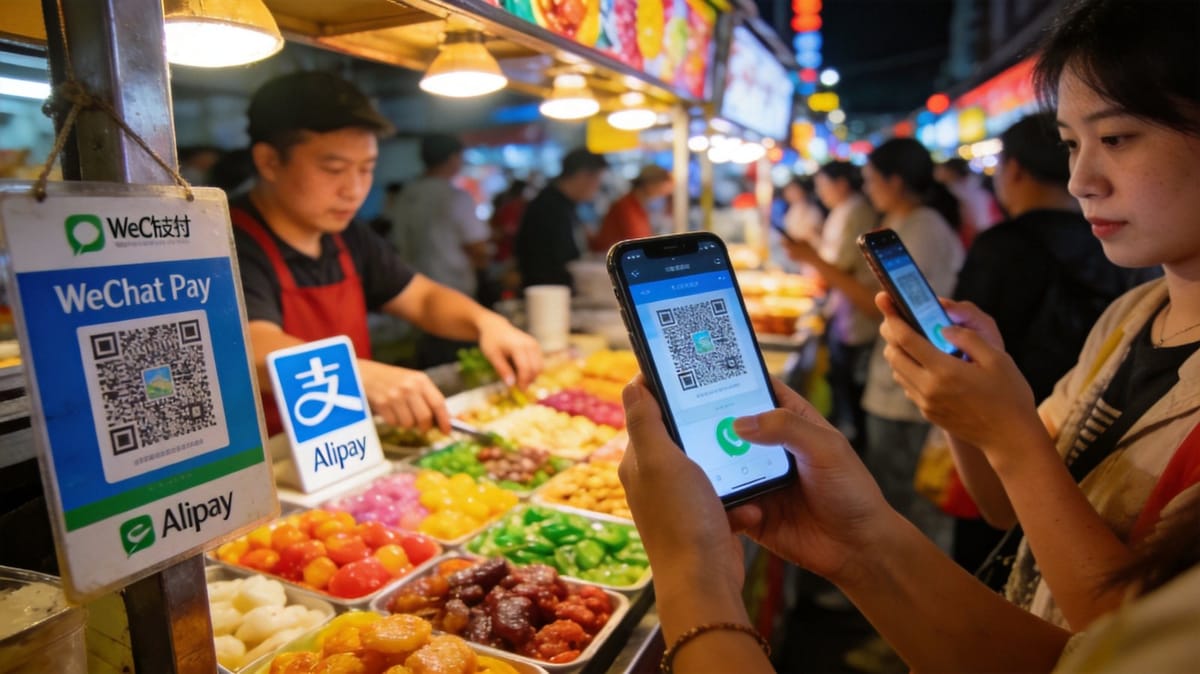
I lived in Shanghai for three months before I realized I hadn't visited an ATM once. Not because I was being deliberate — I just never needed cash. The fruit vendor on the corner had a QR code taped to her cart. The taxi driver pointed at a sticker on his dashboard. The tiny noodle shop with four stools? Yeah, they had a code too. My phone had become the only wallet that mattered.
Then I flew back to New York, and reality hit hard. I stood at a bodega counter, phone ready, and the guy behind the register gave me a look like I'd tried to pay with seashells. "Cash or card," he said. No QR code. No scan. Just the old swipe-and-sign ritual that Americans have been performing since the 1950s.
That contrast stuck with me. How did two parts of the world end up with such wildly different payment cultures? And why — when the technology exists everywhere — does China live in a future that the West can't seem to reach?
The Numbers Don't Lie: China's Mobile Payment Dominance
Let's start with the data, because the gap is genuinely staggering.
China's mobile payment penetration rate hit 86% in 2024, according to the People's Bank of China. Over 953 million people actively use mobile payment services. Mobile wallets account for 84% of all payments in China, based on GlobalData's 2023 Financial Services Consumer Survey. Alipay and WeChat Pay together control over 90% of the digital transaction volume, with Alipay holding roughly 54% market share and WeChat Pay at 42%.
These aren't just online transactions. We're talking about street food, taxi rides, utility bills, hospital visits, even donations to beggars — all done by scanning a QR code. Cash now represents just 3.7% of the money in circulation for transactions in China as of 2023.
Compare that with the United States. Only about 21% of the US population — roughly 60 million people — actively used Apple Pay in 2024. Google Pay? Around 48.6 million users, or 14.5% of Americans. Even combined, that's barely a third of the population using their phones to pay for things. In a 2024 KUBRA survey, 75% of Americans still chose credit cards as their preferred payment method, 71% chose debit cards, and 61% still use cash. Apple Pay came in at just 27%.
Europe tells a similar story. The European Central Bank reports that as of 2024, mobile payments account for only 6% of point-of-sale transactions across the euro area. Cash still makes up 52% of transactions. Contactless cards — not phones — are the preferred bridge between old and new. In the Netherlands, 78% of POS payments are by card or mobile, but the "mobile" part is tiny. It's the tap-to-pay card that dominates.
Why QR Codes Won China and NFC Didn't
Here's the thing that trips people up: the technology gap isn't the issue. Apple Pay works fine. Google Pay works fine. The US has the phones, the networks, and the NFC terminals. China didn't win because it had better tech. It won because it had a better ecosystem strategy.
Alipay launched in 2004 as an escrow service for Alibaba's Taobao marketplace. It solved a specific trust problem: Chinese consumers didn't trust online sellers enough to pay upfront. Alipay held the money until the goods arrived. That trust-building exercise gave Alipay something Apple Pay never had — a reason to exist that went beyond convenience.
WeChat Pay entered the scene in 2013 and grew explosively through the hongbao (red envelope) feature during the 2014 Chinese New Year. Within 24 hours of launch, 16 million red envelopes were sent. A month later, WeChat Pay's user base jumped from 30 million to 100 million. Social pressure did what marketing budgets couldn't.
The real genius, though, was QR codes. While Apple Pay required merchants to buy expensive NFC-enabled terminals — a $500 to $1,000 investment per register — a QR code in China costs nothing. A street vendor prints a QR code on a piece of paper, tapes it to their stall, and they're in business. No terminal. No electricity. No internet connection on their end (the customer's phone handles that). This low-barrier approach meant that literally every merchant, from a luxury mall to a woman selling steamed buns from a cart, could accept mobile payments overnight.
In the West, NFC terminals had to be rolled out merchant by merchant, bank by bank. Apple had to negotiate with Visa, Mastercard, and individual banks. Google had to do the same. It was slow, fragmented, and expensive. China skipped all of that by going directly from cash to QR-code mobile wallets, leapfrogging the entire card-based infrastructure that the West spent decades building.
The Credit Card Trap: Why America Can't Move On
If you want to understand why mobile payments haven't taken off in the US, you need to understand the credit card industrial complex. Americans love their credit cards — and the system loves them back.
The US has over 530 million credit cards in circulation. Credit card rewards — cash back, airline miles, hotel points — are practically a national pastime. The average American household carries four credit cards. Using Apple Pay doesn't change your rewards structure; it just changes how you tap. There's no incentive to switch because the underlying system works the same way.
China never built that credit card culture. Before mobile payments, most Chinese consumers used cash. Credit card penetration was below 20% when Alipay and WeChat Pay took off. There was no entrenched reward system to compete with, no miles to lose, no cashback to miss. The jump from cash to phone felt natural because there was nothing in between worth clinging to.
Venmo and Zelle, often cited as America's answer to mobile payments, are fundamentally different tools. They're peer-to-peer transfer apps — great for splitting dinner bills, useless for paying a street vendor or buying groceries. They don't replace your wallet. They supplement it.
India: The Only System That Rivals China
If there's one country that can claim to be in China's league for mobile payments, it's India — and the story is completely different.
India's Unified Payments Interface (UPI) processed 172 billion transactions in 2024, a 46% jump from 117.64 billion in 2023. In December 2024 alone, UPI handled 16.73 billion transactions worth 23.25 lakh crore rupees (approximately $278 billion). That's an average of over 550 million transactions per day.
But here's the key difference: UPI is government-built. The National Payments Corporation of India (NPCI), a central-bank-owned entity, created the infrastructure, and private apps — PhonePe, Google Pay, and Paytm — compete on top of it. It's an open, interoperable system. Any app can connect to any bank. Any merchant can accept payment from any customer, regardless of which app they use.
China's system is the opposite — two walled gardens (Alipay and WeChat Pay) that dominate everything. For years, a merchant's Alipay QR code wouldn't work with WeChat Pay and vice versa. (Interoperability was mandated by the government in 2021, but the ecosystems remain largely separate.)
Both approaches work at scale, which proves something important: mobile payment adoption isn't about whether you use wallets or bank-to-bank transfers. It's about whether the system is easy enough, cheap enough, and universal enough that not using it becomes harder than using it.
Africa: The Pioneer That Didn't Scale
Long before Alipay or UPI, there was M-Pesa. Launched in Kenya in 2007 by Safaricom, M-Pesa was the world's first truly successful mobile money platform. It gave millions of unbanked Africans a way to store and transfer money using basic feature phones — no smartphone, no internet, no bank account needed.
Today, M-Pesa has about 66 million users across seven African countries and processed over $450 billion in transaction value in the financial year ending March 2025. In Kenya, M-Pesa's market share is 94.9% and its user base covers 75% of the population. These are impressive numbers for a single country.
But scale tells the story. M-Pesa's 66 million users across all of Africa compare to China's 953 million. Its $450 billion annual transaction value sounds big until you realize that Alipay alone processed an estimated $20.1 trillion in 2025. The gap isn't just about population size — it's about the ecosystem depth. M-Pesa is primarily a transfer and savings tool. China's mobile payments are woven into e-commerce, social media, ride-hailing, food delivery, and government services. M-Pesa doesn't have mini-programs or super-app integration. It solves a critical problem — financial inclusion — but it doesn't create the kind of all-encompassing digital lifestyle that makes mobile payments inevitable rather than just convenient.
Europe: The Contactless Card Comfort Zone
Europe presents a fascinating middle ground — and a cautionary tale for mobile payment advocates.
Card payments across the euro area have surged, rising from 19% of POS transactions in 2016 to 39% in 2024. Cash has dropped from 79% to 52% over the same period. But mobile payments? They grew from less than 1% to just 6%. The contactless card — not the phone — is the dominant non-cash method.
Why? Because contactless cards work too well. The European rollout of chip-and-PIN in the 2000s, followed by contactless NFC cards in the 2010s, created a seamless payment experience that doesn't require pulling out a phone, unlocking it, and opening an app. You just tap your card and go. It's fast, it's universal, and every merchant in Europe accepts it.
Sound familiar? It's the same credit card trap as the US, just with a thinner, tap-enabled card instead of a swipe. The existing system works well enough that the marginal improvement of using a phone instead of a card isn't worth the behavioral change.
Privacy also plays a role. A 2024 ECB survey found that 41% of Europeans value cash for its anonymity. In Germany, where cash usage remains above the euro-area average, cultural attachment to physical money runs deep. Mobile payments, which create a digital record of every transaction, face resistance that goes beyond mere habit.
The Real Reason China Pulled Ahead
Strip away the technology, and China's mobile payment dominance comes down to three things that have nothing to do with QR codes or NFC chips:
1. A blank slate. China didn't have an entrenched card system to overcome. Going from cash to phone was a one-step jump, not a two-step process of replacing cards first and then replacing the replacement.
2. Super-app ecosystems. Alipay and WeChat Pay aren't payment apps. They're entire digital lives. Alipay handles e-commerce, wealth management, insurance, micro-loans, and government services. WeChat Pay sits inside an app where you already chat with friends, read news, and order food. Payment is just one feature — but it's the feature you use most often, which locks you in. Apple Pay is a button. Alipay is a universe.
3. Network effects at warp speed. Once enough merchants accepted QR codes, consumers had no reason to carry cash. Once enough consumers stopped carrying cash, merchants had no reason to accept it. The flywheel spun faster in China because the low cost of QR-code adoption meant every merchant — literally every single one — could participate from day one.
None of these factors are about technology. The US has the tech. Europe has the tech. India proved you could build a different kind of system with the same tech. The difference is always culture, infrastructure path-dependency, and whether the ecosystem creates enough gravity to pull everyone in.
Will the West Ever Catch Up?
Probably not on China's terms — and that's okay.
The West won't adopt QR-code payments en masse because there's no reason to. Cards work. Contactless cards work better. Apple Pay and Google Pay are slowly growing, with Apple Pay's user base reaching 744 million globally by 2024, but they're extending the existing card system, not replacing it.
What the West might do is find its own path. India's UPI model — government-built infrastructure with private competition on top — could be a template. The EU is exploring a similar approach with the European Payments Initiative. Brazil's Pix system, launched in 2020, has already reached over 140 million users.
But here's the uncomfortable truth: China's system works because it was built from scratch for a world that didn't have an alternative. The West's systems work well enough that the cost of switching exceeds the benefit. And that means the gap isn't closing — it's just becoming a different kind of gap. China will keep pushing forward with facial recognition payments, digital currency (the e-CNY, which reached 7 trillion yuan in transactions by June 2024), and increasingly frictionless experiences. The West will keep optimizing a 70-year-old card system.
Both work. But only one feels like the future.