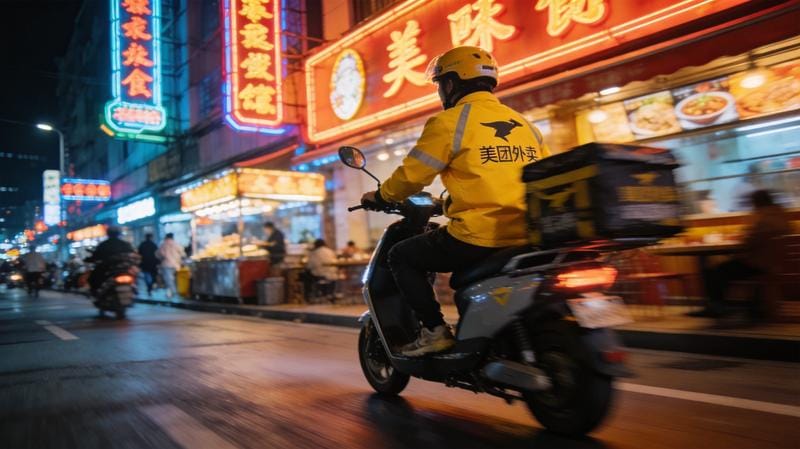
So You're Hungry in China. Good News: Food Comes to You.
Here's the thing about China that catches most foreigners off guard: you can get literally any food delivered to your door in 30 minutes or less. Not just pizza and burgers — I'm talking hot pot ingredients, fresh fruit, pharmacy stuff, a single bottle of water, even someone to fix your phone. The delivery ecosystem here is genuinely unmatched anywhere on the planet.
The two apps you need are Meituan (美团) and Ele.me (饿了么). Think of them as the Uber Eats of China, except they deliver about 10x faster and cost about 1/3 as much. A typical delivery fee is 3-5 yuan (that's 40-70 cents US). Yeah, you read that right.
Setting Up: What You Need Before You Start
First things first — you need a Chinese phone number. Without it, you can't register for anything. If you're visiting, get a prepaid SIM at the airport. China Mobile and China Unicom both have tourist SIMs for around 100-200 yuan with data and voice. You also need Alipay or WeChat Pay set up and linked to a payment method. Cash on delivery exists but it's rare and awkward — the delivery guy has to make change, which nobody carries anymore.
For Alipay, you can now link international credit cards (Visa, Mastercard) directly. Open Alipay → Me → Bank Cards → Add Card. WeChat Pay also supports foreign cards now. Both require real-name verification — you'll need your passport for this step. The verification takes about 5-10 minutes if your photos are clear.
Once your payment is sorted, download Meituan and Ele.me from your app store. Both have some English support, but honestly, the Chinese versions have way more restaurants. If you can't read Chinese, that's okay — I'll walk you through the ordering flow below.
The Meituan Walkthrough (Step by Step)
Open Meituan. You'll see a homepage with a bunch of icons. Tap the one that says 外卖 (wàimài) — it usually has a little motorcycle icon. This is the food delivery section.
Now you'll see restaurants near you. The app automatically detects your location. If it doesn't, tap the location pin at the top and manually enter your address. Setting your address correctly is crucial. Chinese addresses go: city → district → street/compound name → building number → apartment. If you're in a residential compound (小区), you need the compound name — just the street address won't get your food to you. Save your home and work addresses so you don't have to type them every time.
Browse restaurants. Each one shows estimated delivery time (usually 25-40 minutes), minimum order amount, and a rating out of 5. Tap a restaurant to see its menu. Prices are in yuan — a decent meal costs 15-35 yuan ($2-5 USD). Most restaurants show photos of every dish, which helps a lot if you can't read Chinese. Tap a photo to see the dish name in Chinese — you can screenshot it and translate if needed.
When you find something you want, tap the + button to add it to your cart. Some items have options (spicy level, rice or noodles, drink combo) — tap the item to see. When you're done, hit the cart icon in the bottom right, then the big orange checkout button.
On the checkout page: double-check your delivery address, add any delivery notes (like "leave at front desk" or "gate code is 1234#"), and tap pay. That's it. You'll see a real-time map of your delivery driver within seconds.
The Ele.me Walkthrough
Ele.me works almost identically. Open the app, tap 外卖 (wàimài), browse, add to cart, checkout. The main difference? Ele.me is owned by Alibaba, so it integrates nicely with Alipay. Meituan is its own ecosystem but accepts both Alipay and WeChat Pay.
Which one should you use? Honestly, both. Some restaurants are exclusive to one platform, and prices can differ between them. When I want something specific, I check both apps and go with whoever is cheaper or faster. Ele.me tends to have more promotions during lunch hours. Meituan has better late-night options.
Choosing What to Eat When You Can't Read Chinese
This is the biggest barrier for foreigners, and here's how to deal with it. First, use the photo-based browsing — every dish has a picture. If it looks good, add it. Second, look for restaurants with English menus — there's a small but growing number, especially in expat-heavy areas of Shanghai, Beijing, and Shenzhen. Third, screenshot the dish name and pop it into Google Translate or Baidu Translate.
Some safe bets that work everywhere: 炒饭 (chǎofàn, fried rice), 面条 (miàntiáo, noodles), 饺子 (jiǎozi, dumplings), 宫保鸡丁 (gōngbǎo jīdīng, Kung Pao chicken), 番茄炒蛋 (fānqié chǎodàn, tomato and egg stir-fry — the ultimate Chinese comfort food). Print these out or save them on your phone.
Pro tip: search for the cuisine type you want. 川菜 (Sichuan food), 粤菜 (Cantonese food), 日料 (Japanese), 韩料 (Korean), 汉堡 (burgers). The search bar accepts pinyin too — type "hamburg" and you'll get results.
Tracking Your Delivery
Once you place an order, both apps show you a real-time map with your delivery driver's location. You can watch the little motorcycle icon move through the streets toward you. It's weirdly addictive. The app will also show you the rider's name, phone number, and a countdown timer for estimated arrival.
If the rider can't find your address (common in residential compounds), they'll call you. If you don't speak Chinese, have your address written in Chinese on your phone to show the gate guard, or use the in-app chat with auto-translate. Most riders are used to dealing with foreigners at this point — patience and hand gestures go a long way.
When your food arrives, the rider will either hand it to you directly or, more commonly, leave it at a pickup point. Many apartment buildings now have smart lockers — you get a code via SMS, open the locker, and grab your food. No human interaction required. Perfect for introverts.
Pro Tips That Took Me Months to Learn
1. The red packet (红包) system. Both apps give you random discount coupons before every order. Always check — sometimes you get 5-10 yuan off for no reason. Share with friends to unlock bigger ones. There are entire WeChat groups dedicated to sharing red packets.
2. Group ordering (拼单). If you're ordering with coworkers, use the group order feature. One person starts, shares a link, everyone adds their items, and it all comes together with one delivery fee. This is how every office in China does lunch. Minimum order thresholds apply per restaurant, not per person, so grouping saves everyone money.
3. Delivery insurance. For 0.5-1 yuan, you can buy delivery insurance that gives you a full refund if your order is more than 10 minutes late. Always get this. It pays for itself within a week.
4. Schedule ahead. You can order breakfast the night before and schedule delivery for 8 AM. Your food arrives while you're still brushing your teeth. Life-changing for early mornings.
5. Filter by distance. Restaurants closer to you deliver faster. The "nearest first" sort is your friend when you're really hungry. Anything under 1 km usually arrives in under 20 minutes.
6. Look for 月售 (monthly sales). This number tells you how many orders a dish got last month. High numbers mean it's popular and probably good. I never order dishes with fewer than 100 monthly sales.
What If Something Goes Wrong?
Cold food? Wrong order? Missing items? Take a photo and submit a complaint through the app. Both platforms have 24/7 customer service and they almost always side with the customer. I once got a full refund plus a 20-yuan coupon because my noodles arrived slightly lukewarm. The system is built on trust and speed — they want you happy and ordering again tomorrow.
If your order never shows up, you can contact the rider directly through the app. If they marked it as delivered but you didn't get it, report it immediately — the app tracks GPS data and knows if the rider actually came to your location.
Allergic to something? Use the delivery notes field to write your allergy in Chinese. "我对花生过敏" (I'm allergic to peanuts) or "不要辣" (no spice). Most restaurants will accommodate, though cross-contamination is always a risk in busy kitchens.
Beyond Food: What Else Can You Get Delivered?
Everything. Groceries, medicine, flowers, phone chargers, toilet paper at midnight, a live crab for dinner (yes, really), your dry cleaning picked up and returned. Meituan even has a "run errands" service (跑腿) where someone will go buy literally anything for you and deliver it for a small fee of 5-15 yuan. Stuck at home without medicine? 20 minutes later, it's at your door. Forgot a birthday gift? Order flowers and cake on Meituan, both arrive within the hour.
During peak times (11:30 AM - 1:00 PM for lunch, 5:30 PM - 7:30 PM for dinner), delivery times may be longer. Rainy days also slow things down — expect an extra 10-15 minutes. The delivery fee sometimes increases during bad weather too, but it's still absurdly cheap by Western standards.