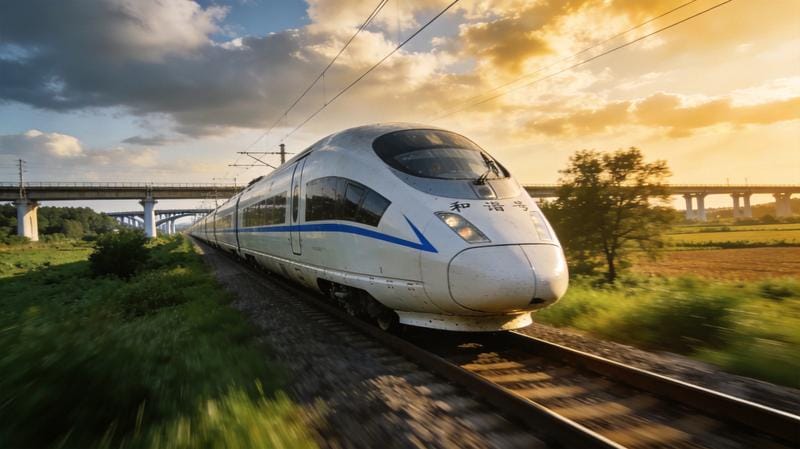
China's Bullet Trains: Faster Than Flying (Sometimes Literally)
Let me paint you a picture. You're in Shanghai and want to visit Hangzhou. You could fly — but that means getting to the airport 90 minutes early, security lines, waiting at the gate, the flight itself, then getting from the airport to the city center on the other end. Total time: about 4 hours, assuming no delays.
Or you take the bullet train. You arrive at Shanghai Hongqiao Station 30 minutes before departure, grab a coffee, walk to your platform, sit in a comfortable seat with legroom and power outlets, and 45 minutes later you're in downtown Hangzhou. Door to door, the train wins almost every time for trips under 1,000 km.
China has over 45,000 km of high-speed rail lines — more than the rest of the world combined. Trains run at 250-350 km/h, connect virtually every major city, and cost a fraction of what you'd pay for a comparable journey in Europe or Japan. A second-class ticket from Beijing to Shanghai (4 hours, 1,318 km) costs about 553 yuan ($77 USD). That same distance on Japan's Shinkansen would cost roughly 3x more.
The 12306 App: Your Ticket to Everywhere
All train tickets in China go through the official 12306 system (铁路12306). Download the app — it has English support now, which is a huge improvement from even two years ago. You can also book on the website (12306.cn), but the app is easier and more reliable.
Here's how to set it up:
Step 1: Download 铁路12306 from your app store. The icon is blue with a white train.
Step 2: Register an account. You'll need your passport number, full name (exactly as it appears on your passport — this matters a lot), and your Chinese phone number for verification.
Step 3: Verify your identity. The app will ask you to take a photo of your passport and a selfie. This usually takes a few minutes to process. Sometimes it fails (bad lighting, blurry photo) — just try again. If it keeps failing, you can verify at any train station ticket counter with your physical passport. The counter staff deal with foreign passports every day.
Step 4: Add a passenger. Even if it's just yourself, you need to add your info as a "passenger" in the system. Go to My → Passengers → Add. Enter your name, passport number, and passport type (foreign passports are fully supported now).
Booking Your Ticket (The Actual Steps)
Open the app. On the home screen, you'll see two fields: departure city and arrival city, plus date. Type the city names in pinyin (like "Beijing" or "Shanghai") or Chinese characters if you can. Select your travel date.
Tap search and you'll see a list of available trains. Each one shows: departure time, arrival time, duration, train number (G-trains are the fastest at 300-350 km/h, D-trains are next at 200-250 km/h), and ticket prices for different seat classes.
Seat classes, explained:
Second Class (二等座): The standard. 5 seats per row (2+3 configuration), similar to economy class on a plane but with more legroom. This is what 90% of people book. Totally fine for any trip under 6 hours. Price example: Beijing to Shanghai, 553 yuan ($77).
First Class (一等座): 4 seats per row (2+2), wider seats, more recline, free snacks on some routes. Worth it for trips over 4 hours if you want extra comfort. Usually about 50-70% more than second class. Beijing to Shanghai: 933 yuan ($130).
Business Class (商务座): Lie-flat seats, lounge access at some stations, complimentary meals. Very fancy, very expensive (3-4x second class). Save this for special occasions or if someone else is paying. Beijing to Shanghai: 1,748 yuan ($244).
Tap the train you want, select your seat class, choose your passenger, and tap submit. You'll have 30 minutes to complete payment. Pay with Alipay, WeChat Pay, or a bank card. Tickets go on sale 15 days before departure — set a reminder for popular routes.
The Seat Selection Hack
After selecting your ticket, you can actually choose your seat. The app shows a seat map — window seats are A and F, aisle seats are C and D, middle seat is B (only in second class). If you want to look out the window, pick A or F. If you need to get up often, go with C or D. You can select a preference, and the system will try to assign it. If the seats you want are taken, try a different train time.
The Easy Alternative: Trip.com
If the 12306 app feels overwhelming (and it can be, even with English support), there's an easier option: Trip.com. Yes, the same travel booking site you use for hotels and flights also sells Chinese train tickets. The interface is fully in English, accepts foreign credit cards without any special setup, and handles the 12306 integration for you behind the scenes.
Here's the tradeoff: Trip.com charges a small service fee (usually 20-40 yuan per ticket) on top of the official price. For a 553-yuan Beijing-Shanghai ticket, you might pay 580-590 yuan total. Not bad for the convenience. You also don't need to deal with passport verification on 12306 — Trip.com handles that part.
The downside? During peak travel seasons (Chinese New Year, National Day holiday in October), Trip.com has fewer tickets available because 12306 prioritizes its own platform. And some discounted tickets may not show up on Trip.com. My advice: try 12306 first, and if it's giving you headaches, use Trip.com as your backup. It's worth the small markup for the peace of mind.
Picking Up Your Ticket (Or Not)
Good news: you don't need a physical ticket anymore. Your passport IS your ticket. Just swipe your passport at the ticket gates at the station. The scanner reads the chip in your passport and opens the gate. It feels like magic the first time.
That said, if you want a paper ticket as a souvenir (or because you're nervous about the e-ticket system), you can print one at any station's self-service machine using your passport. Some machines have English options. Arrive 10 minutes early to do this, just in case.
Important: if you booked through Trip.com, you still use your passport at the gates. The booking platform doesn't matter — all tickets are in the 12306 system.
At the Station: What to Expect
Chinese train stations are huge — think airport-sized. Arrive at least 30 minutes before departure for major stations (Beijing South, Shanghai Hongqiao, Guangzhou South). Smaller stations, 20 minutes is fine.
Security check at the entrance (X-ray for bags, walk-through metal detector — quick, 2 minutes max). Then find your waiting hall — check the big departure boards for your train number and waiting room number. Sit down, relax, and wait for the boarding announcement (usually 15 minutes before departure).
Boarding is orderly. Follow the crowd to the platform, find your car number (marked on the side of the train), and find your seat. Luggage goes in the overhead racks or the large luggage areas at the ends of each car.
The On-Train Experience
Once you're settled, the ride is smooth and quiet. You can walk between cars, use the restroom (clean by public transit standards), or buy snacks from the cart that rolls through every hour. Hot water is available at the end of each car — bring instant noodles and you've got a classic Chinese train meal for 5 yuan. There are power outlets under your seat (universal and USB on newer trains).
Phone signal is generally good on high-speed routes, though it drops briefly in tunnels. Many G-trains now have free WiFi — connect to "SRWS-WIFI" and register with your phone number. Speed is decent for messaging and light browsing.
Common Mistakes Foreigners Make
Wrong name spelling. Your ticket name must exactly match your passport. If your passport says "SMITH JOHN" and you registered as "John Smith," it won't work. The system is picky about this. Double-check before booking.
Going to the wrong station. Big cities have multiple stations. Beijing has Beijing Station, Beijing South, Beijing West, Beijing North, and Qinghe Station. They are NOT interchangeable. Check which station your train departs from — it's printed on your ticket. A mix-up means missing your train and buying a new ticket.
Not booking early enough. Tickets go on sale 15 days before departure. Popular routes (Beijing-Shanghai, Chengdu-Chongqing) sell out fast, especially on weekends and holidays. Book as early as you can. You can always cancel for a small fee (5-20% depending on how close to departure).
Confusing G and K trains. G-trains are high-speed (your best bet). K-trains are slow overnight trains. Don't accidentally book a K-train from Beijing to Shanghai unless you want a 14-hour journey instead of 4 hours. D-trains are a middle ground — slower than G but faster than K, and sometimes cheaper.
Forgetting your passport. This sounds obvious, but you'd be surprised. No passport = no boarding. A photo on your phone won't work. Keep your passport in the same pocket every time so you never forget it.