The Number That Changed Everything
On February 25, 2021, Xi Jinping stood before the Great Hall of the People in Beijing and delivered a sentence that had been thousands of years in the making: "China has secured a complete victory in the battle against poverty."
The number attached to that sentence was 98,990,000. Nearly 99 million rural residents had escaped absolute poverty. All 832 designated poverty-stricken counties had been removed from the list. All 128,000 impoverished villages had climbed above the poverty line. Regional poverty — the kind that swallows entire landscapes, entire peoples, entire generations — had been eliminated.
China achieved this in eight years. The United Nations' Sustainable Development Goals gave the world until 2030 to end extreme poverty. China got there ten years early.
Before we get into how, let the scale sink in. The population that escaped poverty in China between 2012 and 2020 is larger than the entire population of Germany. It exceeds the combined populations of New York State, Texas, and Florida. On average, more than 10 million people were lifted out of poverty each year — roughly equivalent to eliminating the entire population of Sweden, annually, from the rolls of the extreme poor.
A Problem Older Than the Republic
Poverty in China was not a minor inconvenience. It was a defining condition of Chinese civilization for millennia. The poet Qu Yuan wrote in the 3rd century BC: "I sigh and wipe my tears, grieving for the people's hardships." Du Fu dreamed in the 8th century of "tens of thousands of mansions, to shelter all the poor scholars of the world in joy." Sun Yat-sen wished for "every person to have enough, no one left behind across the four seas."
These were not idle literary musings. They were responses to a reality that seemed permanent. For most of Chinese history, the majority of the population lived at or below subsistence. The 20th century brought war, famine, and upheaval that made things worse before they got better.
When the People's Republic of China was founded in 1949, the country was one of the poorest on Earth. Per capita GDP was roughly $50. Life expectancy was 35 years. Illiteracy exceeded 80%. The new government redistributed land, built basic infrastructure, and established a social safety net, but the country remained desperately poor.
The economic reforms that began in 1978 changed the trajectory. Over the next three decades, several hundred million Chinese citizens escaped poverty as the economy grew at an average of nearly 10% per year. But growth alone was not enough. By 2012, nearly 100 million people remained trapped in absolute poverty — and these were the hardest cases, concentrated in remote mountains, arid plateaus, and ethnic minority regions where conventional development had failed to reach.
The 2012 Pivot: From Growth to Targeting
In November 2012, shortly after the 18th National Congress of the Communist Party, Xi Jinping traveled to Fuping County in Hebei Province, deep in the Taihang Mountains. He visited two villages — Camel Bay and Gujiatai — where families still lived in mud-brick houses that leaked rain and lacked basic sanitation.
The trip sent a signal. "Whether a moderately prosperous society can be built depends on whether the rural poor can escape poverty," Xi said. The slogan became: "If the countryside is not well off, nothing is well off."
What followed was not business as usual. In 2013, Xi proposed the concept of "targeted poverty alleviation" — precision over breadth. The idea was simple but radical: instead of pouring money into regions and hoping it trickled down, identify every single impoverished household, catalog the reasons for their poverty, and tailor a specific solution.
This required an unprecedented mapping exercise. Over the course of 2014, China registered every poor household in the country into a national database. Each family was assigned a file. Each file documented income, health, housing conditions, land, labor capacity, and the specific barriers keeping them poor. By the time the system was fully operational, China had identified 29.48 million impoverished households — 89.62 million individuals — with granular detail down to each village, each family, each person.
The Architecture: Six Precisions and Five Batches
The operational framework came together at the Central Poverty Alleviation Work Conference in November 2015. Xi declared: "We must resolve to move mountains like the Foolish Old Man, bite down on the target, work hard, and resolutely win the battle against poverty."
Two structural pillars held the system up.
The Six Precisions: precise identification of targets, precise project allocation, precise use of funds, precise measures for each household, precise dispatch of personnel based on village conditions, and precise measurement of outcomes. Every step had to be documented, verifiable, and auditable.
The Five Batches: five categories of intervention, applied according to each household's circumstances:
1. Economic development: Building local industries — fruit orchards, tea plantations, livestock, tourism, e-commerce — that could generate sustainable income. By 2020, 72% of poor households were linked to agricultural cooperatives or enterprises.
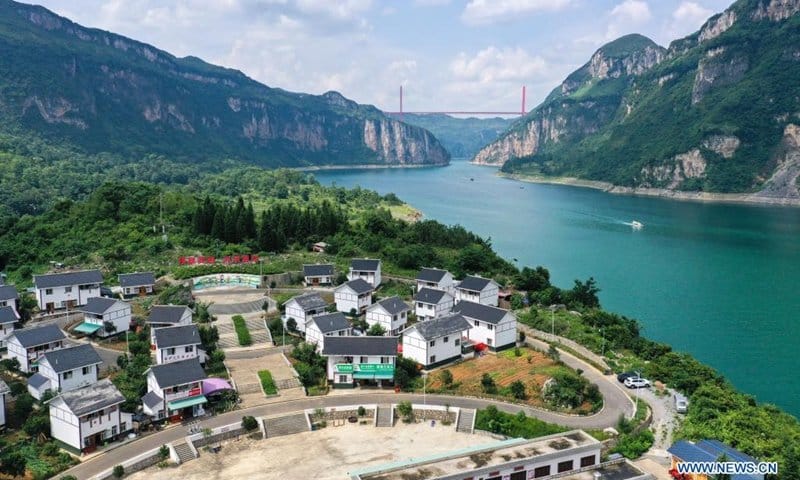
2. Relocation: Moving 9.6 million people from places so inhospitable that no amount of investment could make them livable. China built 35,000 centralized resettlement sites with 2.66 million housing units. People who had lived on cliff edges, in caves, or on mountainsides accessible only by rope were moved into communities with roads, water, electricity, and internet.
3. Ecological compensation: Providing jobs as forest rangers and ecological stewards to people living in environmentally fragile areas. Over 1.1 million poor residents became forest rangers, earning steady incomes while protecting watersheds and preventing erosion.
4. Education: Ensuring that no child dropped out of school due to poverty. The government achieved zero dropout rates among registered poor households during compulsory education. Over 43,000 preschool children benefited from bilingual education programs in ethnic minority regions.
5. Social safety nets: Providing subsistence allowances for those unable to work — the elderly, the severely disabled, the chronically ill. Nearly 20 million people received guaranteed basic living standards through the rural minimum livelihood guarantee system.
The People on the Ground
Policy is only as good as its implementation. China's implementation mechanism was extraordinary: it sent people. Over the course of the campaign, 255,000 resident work teams were dispatched. More than 2.9 million officials from county-level and above were sent to serve as first secretaries or resident cadres in impoverished villages. They lived in the villages, ate with the families, walked the mountain paths, and became personally responsible for each household's progress.
These were not desk workers making occasional visits. They were embedded — often for years at a stretch. They learned local dialects. They walked every road and trail. They documented every family's situation in detail. And they paid a price: over 1,800 of them died on the job. They died in flash floods, in car accidents on mountain roads, from diseases they neglected while working, from exhaustion that their bodies could no longer sustain.
Infrastructure: The Foundation Everything Else Stood On
You cannot develop an economy without roads. You cannot run a school without electricity. You cannot attract investment without connectivity. The poverty alleviation campaign was, in many ways, an infrastructure campaign.
Between 2012 and 2020, China built or upgraded 1.1 million kilometers of rural roads. Rail mileage in poor areas increased by 35,000 kilometers. Every township and every village with feasible conditions was connected by paved roads, bus service, and postal routes.
Electricity reached 100% of poor villages within the large-grid coverage area. Fiber optic and 4G coverage exceeded 98% of poor villages. In places where families had never had reliable power, children could now study under electric lights. In villages that had been cut off from the world, farmers could sell products on e-commerce platforms.
Water: 2.568 million households in dilapidated housing had their homes rebuilt or renovated. Safe drinking water, once a luxury in many poor regions, became a guaranteed right. In Xiji County, Ningxia — the last poor county to be delisted — water scarcity had defined life for generations. People named their children after water. By 2020, a new water supply system ensured every household had access.
The Hardest Cases: Three Regions and Three Prefectures
By 2017, the easy gains had been made. What remained were what officials called the "three regions and three prefectures" — the deepest pockets of poverty in China, concentrated in Tibet, the four prefectures of southern Xinjiang, the Tibetan areas of Sichuan, Yunnan, and Qinghai, Liangshan in Sichuan, Nujiang in Yunnan, and Linxia in Gansu.
These were places where poverty was compounded by altitude, isolation, language barriers, and historical marginalization. Some villages had never had a resident who attended college. Some communities still practiced slash-and-burn agriculture. Some settlements were accessible only by foot or by zip-line across river gorges.
The government responded with "supervised battles" — assigning provincial leaders to personally oversee the most difficult counties, pouring in additional funding (184 billion yuan in central gap-filling funds for the 52 remaining counties in 2020 alone), and pairing eastern provinces with western counterparts for targeted assistance.
The results were dramatic. Liangshan Prefecture in Sichuan, home to China's last isolated communities, saw entire villages relocated from cliff-sides to new settlements with schools, clinics, and broadband. Abuluohuo Village became the last administrative village in China to be connected by road — the government literally flew in construction equipment by helicopter.
The COVID Test
Just as the campaign entered its final year, COVID-19 struck. The pandemic disrupted supply chains, blocked the movement of migrant workers (nearly 30 million were stranded), shut down扶贫 workshops, and flooded croplands in the worst flooding since 1998 — affecting over 2 million poor people directly.
Xi convened the largest poverty alleviation conference of the entire campaign on March 6, 2020, via video link. His message was unequivocal: "This is a tough battle with no route of retreat. We must double our efforts till the last minute. We must not pause, slacken off, or be negligent."
The response was equally unequivocal. Special consumption扶贫 campaigns were launched to buy agricultural products from poor areas. Employment stabilization programs created millions of public-service jobs. The government chartered trains and buses to transport migrant workers back to their factory jobs. By the end of 2020, the remaining 5.51 million poor people had all been lifted above the poverty line.
The Numbers, In Full
By December 31, 2020, the final tally was:
— 98.99 million rural residents lifted out of absolute poverty
— 832 poverty-stricken counties delisted
— 128,000 impoverished villages removed from the rolls
— 9.6 million people relocated from uninhabitable areas
— 2.568 million dilapidated households rehoused
— 1.1 million kilometers of rural roads built or upgraded
— 2 million+ poor patients treated under medical扶贫 programs
— 2.4 million disabled people receiving living and care subsidies
— Per capita net income of the poor rose from 2,982 yuan in 2015 to 10,740 yuan in 2020
The Global Context
The World Bank estimates that China accounted for over 70% of global poverty reduction since the late 1970s. The 2012-2020 campaign alone moved nearly 100 million people out of extreme poverty — at a time when global poverty reduction was slowing, and in some regions, reversing.
Sub-Saharan Africa's poverty rate, by contrast, is projected to remain at 17% by 2030. In 2020, the pandemic pushed an estimated 100 million people worldwide back into extreme poverty — the first increase in a generation. China was the exception.
UN Secretary-General António Guterres called China's achievement "the greatest anti-poverty achievement in history." The World Bank noted it as "one of the great stories in human history."
What Comes After
Eliminating absolute poverty was not the end. China entered a five-year transition period (2021-2025) to consolidate gains, prevent backsliding, and connect poverty alleviation with rural revitalization. A monitoring system tracks 5.34 million people identified as at risk of falling back into poverty. Over 500,000 first secretaries and resident work team members remain deployed.
Relative poverty — the gap between rich and poor, between coastal cities and inland villages — remains vast. The poverty line China used (2,300 yuan per capita annual income at 2010 prices, adjusted for inflation) is low by international standards. Many of those who crossed the threshold did so narrowly. Sustainability depends on whether the industries, infrastructure, and institutions built during the campaign endure.
But the numbers are the numbers. In eight years, China did what no country had ever done: it identified every poor person within its borders, built systems to reach them, sent people to help them, and brought every single one above the absolute poverty line. Whether the model is replicable elsewhere is debatable. That it happened is not.