Living in the Path of the Sand
Over 400 million people in China deal with sand on a regular basis. Not the beach kind — the kind that swallows your farmland, buries your village, and turns your sky orange for days at a time. From the northeast down to the northwest, eight major deserts and four vast sandy regions stretch across the country like a belt of dried-out misery.
By the 1970s, things were getting critical. The Gobi Desert was creeping south at an alarming rate. Every spring, sandstorms hammered Beijing and the entire North China Plain. People would wake up to find a fine layer of yellow dust on everything — windowsills, car hoods, kitchen tables, inside their lungs. Farmers watched helplessly as topsoil blew away and their fields turned to sand.
Something had to be done. And when China decides to do something, the scale tends to be ridiculous.
Enter the Three-North Shelter Forest
In 1978, China launched what it called the Three-North Shelter Forest Program. The "Three Norths" refer to the northwest, north, and northeast regions — a strip covering 13 provinces and over 4 million square kilometers. That is roughly 42% of China's total land area.
The plan was straightforward in concept and brutal in execution: plant trees. Billions of them. Build a wall of green to hold back the advancing desert. The timeline? Seventy-three years, broken into eight phases, running all the way to 2050.
Forty-plus years in, and the results are visible from space.
How Do You Plant a Forest in a Desert?
The short answer is: very slowly, one square at a time.
The technique that made it work is called straw checkerboard sand fixation. Workers lay out squares of straw in a grid pattern across the sand, each square about a meter wide. The straw catches the wind and keeps the sand from shifting. Inside each square, you plant a seedling. Water it by hand if you have to. Wait and pray.
Sounds simple. It isn't. The survival rate for seedlings in some areas was below 20% in the early years. Sandstorms would wipe out months of work overnight. Summers hit 40 degrees Celsius. Winters dropped to minus 30. Water had to be trucked in. Workers lived in tents in the middle of nowhere.
But they kept going. Year after year. Generation after generation.
The Places That Proved It Could Work
In the Mu Us Desert — also known as the Maowusu Sandy Land — something remarkable happened. After decades of relentless planting and careful management, the desert shrank so dramatically that it was officially downgraded from "desert" to "sandy land." Parts of it are now covered in shrubs and trees that nobody thought could survive there.
The Kubuqi Desert tells a similar story. Once a barren expanse of dunes, it now has vegetation covering over half its area. Solar panels and greenhouses sit where there was nothing but sand. International organizations have studied it as a model for desert reclamation.
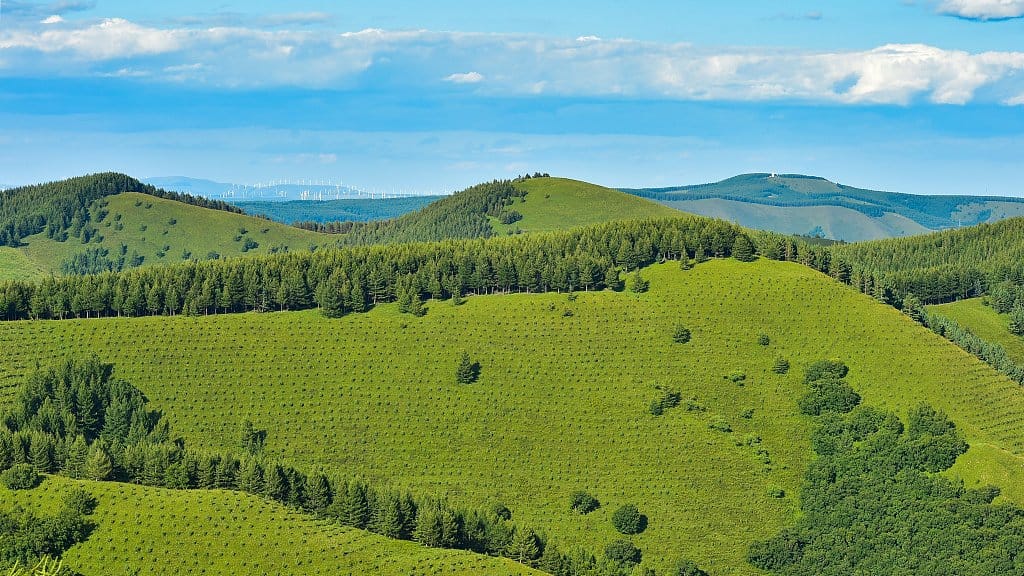
And then there is Saihanba. Once a royal hunting ground that degraded into a wasteland, it took three generations of foresters to turn it back into the largest man-made forest in the world — over 750,000 acres of trees where there was nothing but sand and stone. It won a UN Champions of the Earth award in 2017.
The Numbers Today
China's desertified and sandy land area has been declining year over year since the early 2000s. Forest coverage in the Three-North region has roughly tripled since 1978. Sandstorms hitting Beijing have dropped significantly in frequency and severity.
None of this happened by accident. It happened because millions of people — farmers, soldiers, students, retirees — showed up year after year to dig holes in the sand and put trees in them. Some of those people spent their entire working lives at it. Some passed the job to their children.
What the Rest of the World Still Doesn't Get
Western coverage of the Three-North Shelter Forest often comes with caveats. Some of the trees were the wrong species. Some areas planted too densely and the trees competed for water. Monoculture plantations aren't the same as natural forests. All of that is true.
But here's the thing: China wasn't trying to recreate pristine ecosystems. It was trying to stop its country from turning into one giant sand dune. And on that front, it worked. The sand is retreating. The land is recovering. The air is cleaner. Millions of people's lives are measurably better.
You can critique the method while still respecting the result. China spent forty years doing what no other country has ever attempted at this scale. Whether you call it a forest program, an infrastructure project, or just stubborn refusal to accept defeat — it worked.