A Number and a Name
In December 2021, China's Ministry of Veterans Affairs confirmed the figure in an official response to a National People's Congress proposal: over 1,800 people had died in the line of duty during the poverty alleviation campaign. They were recognized as martyrs, public servants who died in the line of duty, or workers who died on the job.
1,800. Say it out loud. One thousand eight hundred people who went to work one morning and never came home. Who kissed their children goodbye and drove mountain roads in the rain. Who postponed hospital visits because there was one more village to reach. Who collapsed at their desks with next week's schedule already written.
This is an attempt to record their names. Not all of them — the full list has not been made public. But as many as can be found in official reports, state media, and public records. Each name is a person. Each person is a family that waits by a door that will never open again.
The List
What follows is drawn from official Chinese sources: Xinhua News Agency, People's Daily, CCTV, the Organization Department of the CPC Central Committee, and local government records. Where possible, each entry includes the person's name, position, location, age, and cause of death. Where details are sparse, the name alone stands.
| Name | Position | Location | Age | Cause |
|---|---|---|---|---|
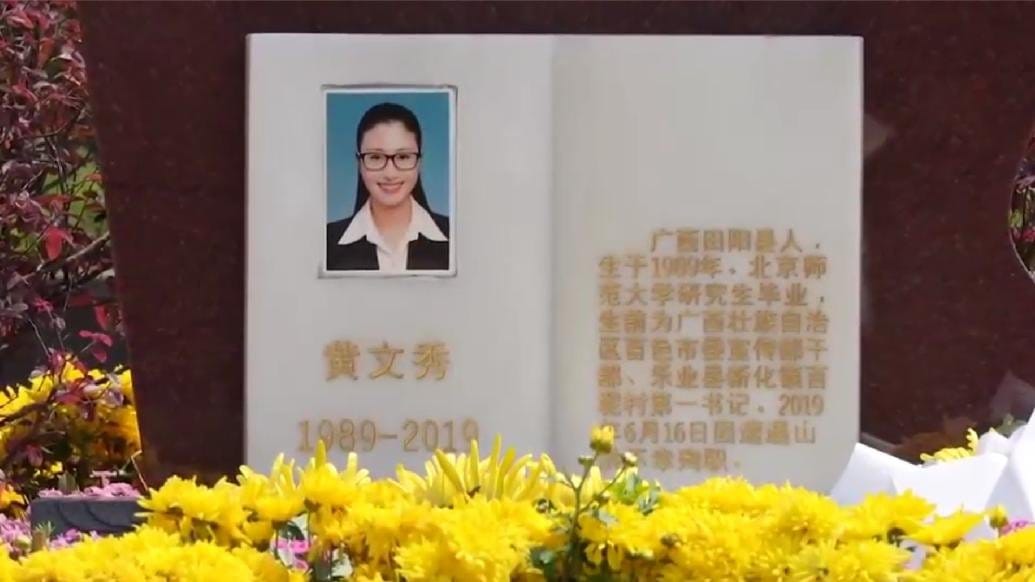
| Huang Wenxiu (黄文秀) | First Secretary, Baini Village | Guangxi, Baise | 30 | Flash flood |
| Jiang Shikun (姜仕坤) | County Party Secretary, Qinglong | Guizhou, Qinglong | 46 | Heart failure from overwork |
| Zhang Xiaojuan (张小娟) | Deputy Director, Poverty Alleviation Office | Gansu, Zhouqu | 34 | Vehicle crash into river |
| Wu Yingpu (吴应谱) | First Secretary, Yongyang Village | Jiangxi, Xiushui | 28 | Car crash |
| Fan Zhenzi (樊贞子) | Aid Worker, Dachong Township | Jiangxi, Xiushui | 23 | Car crash (pregnant) |
| Wang Qiuting (王秋婷) | Village Work Team Member | Yunnan, Daguan | 26 | Car crash |
| Wu Guoliang (吴国良) | Deputy Director, Poverty Alleviation Office | Yunnan, Dongchuan | 33 | Sudden illness from overwork |
| Wang Xinfa (王新法) | Volunteer, Honorary Village Director | Hunan, Shimen | 64 | Heart attack at bridge construction site |
| Yi Xiaofeng (弋肖锋) | First Secretary, Sulu Village | Qinghai, Yushu | 53 | Illness from overwork at 4,000m altitude |
| Yu Fen (余芬) | Poverty Alleviation Cadre | Sichuan, Gulin | 45 | Car crash delivering TV to poor household |
| Jiang Fuan (蒋富安) | First Secretary, Si'eji Village | Sichuan, Meigu | 26 | Sudden cardiac death from exhaustion |
| Meng Han (蒙汉) | County Party Secretary, Xupu | Hunan, Xupu | 55 | Sudden illness during work |
| Yu Yongliu (余永流) | Agricultural Worker, Guanba Village | Guizhou, Zunyi | 33 | Sudden illness from overwork |
| Lan Biaohe (蓝标河) | Deputy County Head, Rong'an | Guangxi, Rong'an | 44 | Overwork, collapsed at desk |
| Ma Xinjuan (马新娟) | Township Party Secretary, Huanghua | Ningxia, Jingyuan | — | Lymphoma (concealed to keep working) |
| Zhang Jianshan (张建山) | Village Work Team Leader | Shanxi, Wutai | — | Fell from roof fixing chimney for villagers |
| Geng Zhanyu (耿展宇) | Poverty Alleviation Cadre | Guizhou, Bijie | — | Motorcycle crash verifying household data |
| Wen Weihong (文伟红) | First Secretary, Daping Village | Guizhou, Yanhe | 45 | Electrocution checking tobacco crops |
| Qing Fanghua (青方华) | Village Party Secretary, Xiaoba | Sichuan, Jiangyou | 48 | Vehicle fell off cliff during village visit |
| Zhang Xiudai (张秀代) | Village Party Secretary, Majia | Sichuan, Yuechi | ~60 | Lung cancer from overwork |
| Li Helin (李和林) | Village Party Secretary, Lijiaba | Sichuan, Nanchong | 52 | Stomach cancer, worked until last days |
| Wang Chuan (王川) | Director, Highway Bureau | Sichuan, Leshan | 53 | Rock collapse during road survey (+ 6 colleagues) |
| Liu Xizhou (柳西周) | Village Cadre, Chaping | Anhui, Jieshou | — | Illness, delayed hospital visits |
| Chai Shengfang (柴生芳) | County Mayor, Lintao | Gansu, Lintao | 45 | Overwork, died after 17.5-hour workday |
| Xi Shiming (席世明) | Tianjin Aid Cadre to Xinjiang | Xinjiang, Yutian | — | Cerebral hemorrhage, forgot blood pressure medication |
| Huang Shiyan (黄诗燕) | County Party Secretary, Yanling | Hunan, Yanling | 56 | Heart attack after poverty meeting |
| Qin Yanjun (秦彦军) | Township Party Secretary, Longlin | Gansu, Lixian | 42 | Sudden illness, delayed treatment for flood relief |
| Ni Yibao (倪裔豹) | First Secretary, Daqing Village | Guizhou, Liuzhi | — | Illness from overwork |
| Xie Shifa (谢仕发) | "Doctor Secretary", Fengshubei Village | Jiangxi, Jishui | — | Collapsed outside village office |
| Ding Yonghua (丁永华) | First Secretary, Yangji Village | Guizhou, Sandu | — | Severe hypertension, refused to leave post |
| Ju Yanjun (巨彦军) | Township Head, Yangjiao | Shanxi, Zuoquan | 37 | Died in sleep after severe headache |
| Qiu Jun (邱军) | Deputy County Head (seconded) | Gansu, Huachi | — | Illness, wrote 3 final work tasks before dying |
| Huang Zhongcheng (黄忠诚) | Village Cadre | Guizhou | — | Collapsed at dividend distribution ceremony |
Wang Chuan's entry deserves a note: when the rock face collapsed on March 8, 2016, it killed seven people. One of them was still clutching a construction blueprint when rescuers found the body beneath a thousand-pound boulder. Their names, beyond Wang Chuan, have not been widely reported.
The table above captures thirty-three names. The actual number of dead exceeds 1,800. Most of their names have not appeared in any English-language publication. Many have not appeared outside local Chinese media. The complete roster — if one exists in a single document — has not been released.
Huang Wenxiu: The Girl Who Came Back
Huang Wenxiu was born in 1989 in Tianyang County, Guangxi, into a Zhuang ethnic family. She graduated from Beijing Normal University with a master's degree. Her neighbors called her the golden phoenix who had flown out of the mountains.
She flew back.
"Many people leave the countryside and never want to return," she said. "But someone has to come back. I am that person."
In March 2018, she volunteered to serve as first secretary of Baini Village in Leye County, deep in the mountains of western Guangxi. The village had 460 households and a poverty rate of 22.88%. When she arrived, villagers wouldn't open their doors for her. A young woman, a university graduate, from the city — what could she possibly understand about their lives?
She learned the local dialect. She helped villagers sweep their courtyards and work their fields. She drew a hand-drawn map of every household in the village, marking names and locations. She bought a car on loan and learned to drive on mountain roads. Within a year, 88 households — 418 people — had escaped poverty. The poverty rate dropped to 2.71%.
On June 16, 2019, Huang Wenxiu was in Tianyang visiting her father, who had just undergone a second surgery. The weather forecast warned of heavy rain. She told her father to take his medicine, got in her car, and drove toward Baini. She was worried about flooding in the village.
Colleagues messaged her, begging her to turn back. She kept driving. That night, a flash flood swept through the mountain road. She was 30 years old.
At the national poverty alleviation commendation ceremony on February 25, 2021, when the list of model individuals was read, the camera caught an old man with white hair wiping away tears. His name was Huang Zhongjie. He was her father.
Wu Yingpu and Fan Zhenzi: "To Be Continued"
Fan Zhenzi was 23 years old. She made a scrapbook for her husband, Wu Yingpu, documenting their relationship in meticulous, joyful detail:
"October 29, 2017 — First formal meeting.
February 8, 2018 — First time holding hands.
April 4 — First outing together.
June 1 — Marriage certificate.
November 7 — I'm going to marry you."
On the last page, she wrote: "To be continued."
Wu Yingpu, 28, was first secretary of Yongyang Village in Xiushui County, Jiangxi — the most remote, deeply impoverished village in the county. In less than a year, he filled eight thick notebooks with work logs, oversaw the hardening of 8.6 kilometers of village roads, and built a 103-mu mulberry and silkworm base.
Fan Zhenzi was pregnant. She also worked as a poverty alleviation cadet in Dachong Township, juggling multiple roles — women's affairs, organization, tax coordination — while carrying a child.
On December 16, 2018, forty days after their wedding, the couple drove three hours to visit a poor household in Chuancang Village. On the winding mountain road back, their car lost control and went into a river. Both died. The unborn child died with them.
"To be continued" became an ending.
Jiang Shikun: The Farmer Secretary
Jiang Shikun was a Miao ethnic man who became County Party Secretary of Qinglong in Guizhou, one of the poorest counties in China. When he took office in 2010, 122 of the county's 181 villages had poverty rates above 50%.
He drove himself relentlessly. In six years, he traveled 600,000 kilometers — his shoes wore through, his hair turned white. He developed the "Qinglong sheep," a new breed suited to the karst landscape. He pushed for reservoir construction, power grid upgrades, and road building.
In his final week, his schedule was packed: meetings in Xingyi, inspections in Qinglong, a trip to Guangzhou. Several times, he relied on heart medication to push through chest pain. On April 11, 2016, he collapsed in Guangzhou and was hospitalized. On April 12, at 6 a.m., he died in his sleep. He was 46.
"Secretary Jiang was worked to death," the people of Qinglong said, weeping.
Chai Shengfang: The Last 24 Hours
Chai Shengfang was the county mayor of Lintao in Gansu, one of the poorest regions in China. He held a doctorate and could have pursued a comfortable academic career. Instead, he chose to serve in a place known since antiquity as "bitter beyond measure."
In three years, he visited 281 of Lintao's 323 villages, kept 29 work diaries totaling over 1.7 million characters, and reduced the county's poor population from 110,000 to under 50,000.
His last day, August 14, 2014, was 17.5 hours long: eight work items, including hearing water bureau reports, meeting petitioners, inspecting an irrigation project, hosting a scholarship ceremony, and presiding over a six-hour meeting covering 22 major agenda items and 53 sub-items. He didn't leave his seat once during the six-hour session.
The next morning, the always-punctual county mayor didn't appear for breakfast. When they opened his office door, they found he had died in the night. The blanket covered only one corner of his body. A half-eaten turnip sat beside him. He was 45.
Ma Xinjuan: The Peach Blossom
Ma Xinjuan was the Party Secretary of Huanghua Township in Ningxia. She was relentless. When villagers refused to stop planting winter wheat — their tradition for centuries — she stationed herself at the fields at 5 a.m. and physically blocked farmers from sowing, persuading them one by one to switch to corn for cattle feed instead. It worked.
In three years, Huanghua's poverty population dropped from 3,571 to 68. Ma Xinjuan's weight dropped from 140 to under 100 pounds.
She had lymphoma. She told no one. She continued working through chemotherapy, concealing the swelling, the pain, the injections of pethidine. "The decisive battle is upon us," she told a colleague. "I want you to stay focused."
Two weeks before she died, barely able to sit up, she asked her husband to drive her past the township she had transformed. He laid her in the back of their SUV. Her sister held her head. Through the window, she looked at the new roads, the new bridges, the flowers along the highway. She couldn't speak anymore. She just looked.
A villager compared her to a peach blossom — blooming in the coldest early spring, lighting up the barren mountainside, gone too soon.
Zhang Xiudai: The Road Was His Life
Zhang Xiudai was a former soldier who had served as Party Secretary of Majia Village in Sichuan since 1985 — over thirty years. The village sat in a bowl-shaped valley surrounded by mountains. No roads meant no future. For twenty years, he badgered, begged, and fought to get a road built.
When the road project finally came through, he was inseparable from the construction site. He measured every inch with a tape measure, watching for any sign of substandard work. "Blink once, and someone cuts corners. My road gets ruined," he said.
Then came the poverty alleviation campaign — fruit trees, fish ponds, pepper plantations. He threw himself into all of it. But his body was failing. Lung cancer. He couldn't eat. He couldn't sleep. Still he worked.
"If poverty alleviation isn't done, that's my greatest shame," he said from his deathbed.
The night they buried him, a thunderstorm broke over the village. Men, women, and children lit torches and walked the road he had built, crying, the firelight stretching across the entire valley.
Yu Yongliu: The Letter to His Daughter
Twenty-one days after his daughter was born, Yu Yongliu wrote her a letter in the style of a minister petitioning a princess:
"Please forgive your minister for leaving again without saying goodbye. Your Highness is still in swaddling clothes, not yet a month old. I should not leave so soon, leaving you babbling alone. My heart cannot bear it. I am ashamed. I present this letter to express my resolve."
He was working as a poverty alleviation cadre in Guanba Village, Guizhou. He died on December 1, 2020, at the age of 33, from illness caused by overwork. At his funeral three days later, his not-yet-three-year-old daughter — the "princess" — did not understand what had happened. Her minister had departed without farewell.
The Ones We Cannot Name
The table above lists thirty-three individuals. The official number is over 1,800. That gap — 1,767 names — represents people whose stories have not been told in national media, whose families grieve quietly in villages without reporters, whose sacrifice was recorded in a county file but not in a newspaper headline.
They were village committee members who fell from mountainsides while inspecting irrigation channels. They were young graduates from Beijing and Shanghai who couldn't adjust to the altitude in Tibetan areas and died of cerebral edema. They were township accountants who had heart attacks while reconciling扶贫 fund disbursements at 2 a.m. They were drivers who lost control on rain-slicked mountain roads. They were retired soldiers who came back to help their home villages and never left.
The causes of death cluster into four categories: traffic accidents on dangerous mountain roads, natural disasters — flash floods, landslides, rock collapses — illness concealed or untreated because the work seemed more urgent, and sheer physical exhaustion. In a very real sense, they were casualties of a war — a war against poverty that demanded the same sacrifices wars always demand.
By the end of 2020, China had dispatched 255,000 resident work teams and over 2.9 million officials to serve as first secretaries or resident village cadres. They were the largest peace-time mobilization of government personnel in modern Chinese history. Of those millions, 1,800 did not return.
The Weight of a Name
There is a tendency, when the numbers are this large, to lose the individual. Ninety-nine million lifted from poverty. One thousand eight hundred dead. These are statistics — necessary, powerful, but ultimately abstract. A number cannot mourn. A percentage cannot grieve.
But a name can.
Fan Zhenzi, 23, pregnant, whose love story ended on page five with the words "to be continued." Jiang Fuan, 26, whose Yi villagers bought him new ethnic clothes for his burial and called his father "Jiang Aba." Ma Xinjuan, who hid her cancer from everyone, and whose last wish was to drive past the township she had transformed. Zhang Xiudai, whose village walked his road by torchlight on the night he died. Wang Xinfa, 64, a retired policeman who spent his pension building bridges in a village not his own, and who died mid-sentence discussing the design of the sixth one.
They did not set out to become martyrs. They set out to do a job — to help people they could have ignored, in places they could have avoided, under conditions they could have refused. The fact that they died does not make them better than the millions who survived the same work. It makes them unlucky. And it makes them worth remembering.
The 1,800 did not die for a slogan or an abstraction. They died on specific roads, in specific floods, at specific desks, in specific villages with specific names. They left behind specific children, specific spouses, specific parents who still wait for a footstep that will not come.
This article cannot list all 1,800 names. No single English-language source has attempted to list even a fraction of them. But the attempt matters. Because the opposite of forgetting is not remembering in general — it is remembering in particular. It is saying: this person existed. This person worked. This person died. And this person's name deserves to be read.